
With heat waves that have made this summer a bust for baking, I’ve had to find no-bake treats to satisfy my sweet tooth. During hot, sticky days, nothing beats ice cream, so that’s where I landed. I churned my way through a half-dozen books on the subject, providing friends and coworkers with many pints to sample. After reading, re-reading, jotting down notes, and making gallons of ice cream, I decided to share my thoughts about how these books stack up. The books are The Perfect Scoop, Revised and Updated by David Lebovitz, Jeni's Splendid Ice Creams at Home: More Than 100 Addictively Good Artisanal Recipes by Jeni Britton Bauer, Salt & Straw Ice Cream Cookbook by Tyler Malek and J. J. Goode, Hello, My Name Is Ice Cream: The Art and Science of the Scoop by Dana Cree, Van Leeuwen Artisan Ice Cream by Laura O’Neill and Ben Van Leeuwen and Peter Van Leeuwen and Olga Massov, and Rose's Ice Cream Bliss by Rose Levy Beranbaum.
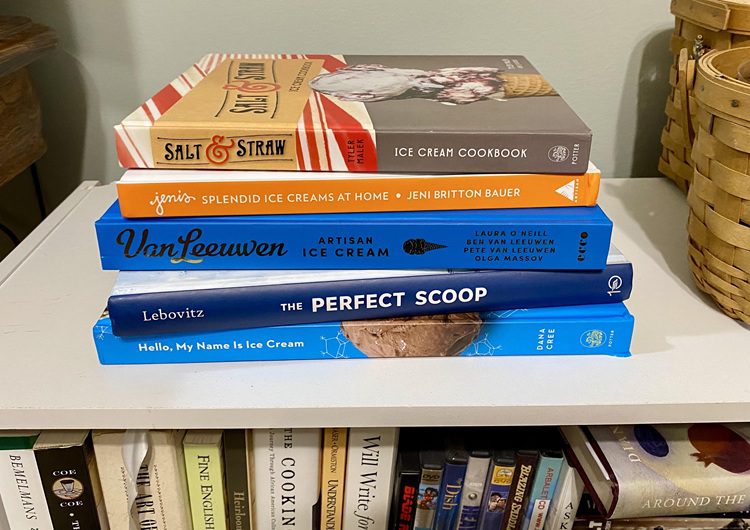
First, the good news: with these books, it is almost impossible to make bad ice cream. All provide useful information on ingredients, equipment, and ice cream science (some more in-depth than others), along with recipes showcasing basic and adventurous flavors. Visually, they all stick to traditional layouts coupled with high-quality photographs. The writing styles range from warm and personal (Lebovitz, Van Leeuwen, Berenbaum) to irreverent (Malek) to friendly and authoritative (Britton Bauer, Cree). While all the books have something to offer, each has its unique strengths and vibe.

One issue that separates these tomes is the author’s approach to stabilizers and emulsifiers. The hardest part of making ice cream at home is keeping the mixture from becoming icy and grainy. Home ice cream machines don’t spin as fast or incorporate as much air as commercial units, so having sufficient emulsifiers and stabilizers is crucial to achieving a smooth, creamy product. Some authors scrupulously avoid adding any gums or starches to their ice cream, relying on the emulsifying properties of egg yolks, which contain lecithin, along with a high ratio of cream to milk. In this group are the Van Leeuwen gang and David Lebovitz.
Rose Levy Beranbaum also utilizes a high butterfat content and egg yolks, but adds glucose syrup as insurance and provides options for commercial stabilizers or starches. Jeni Britton Bauer employs a novel method, using cream cheese (and its built-in gums) along with either cornstarch or tapioca starch in all her recipes. Tyler Malek unabashedly embraces stabilizers and emulsifiers using xanthan gum, dry milk powder, and/or light corn syrup in all his base recipes. Dana Cree likewise promotes stabilizers and provides options to use one of four different stabilizers for each recipe, creating a choose-your-own adventure.
Another distinction between the books is whether they focus on custard-style (using egg yolks) or Philadelphia-style (egg-free) ice cream. Here’s where each book lands on the custard/Philadelphia-style spectrum:

While these books provide sorbet, sherbet, and/or granita recipes too, this review focuses on the ice cream offerings, which made up the bulk of the recipes in each. Here’s how the books stacked up (in reverse alphabetical order by title):
Van Leeuwen Artisan Ice Cream: One of three books by ice cream shop owners, the authors’ passion for creating old-fashioned, artisanal ice cream is evident. I was drawn to the classic, elegant lines in the straightforward layout. To me, this is what a practical cookbook should look like. The headnotes provide useful information, and the color for the headnotes matches the color of each chapter’s first page, creating a sense of cohesion. The instructions are clear and easy to follow, if a little wordy. This book is for frozen custard lovers: each recipe uses 6-8 egg yolks in lieu of added stabilizers. However, there is an entire chapter on vegan ice creams, and a helpful section on what to do with the leftover egg whites.
The Black sesame ice cream boasted a lovely roasted nut flavor and smooth texture. There was one tiny hiccup with this recipe, however. The finished ice cream didn’t have the “inky” color promised. Next time I would swirl in the black sesame paste at the end for a streaked effect instead of having ice cream the color of wet cement (it was delicious nevertheless). My husband—not a fan of unusual flavors—said “this is actually not bad.” That’s high praise.

Salt & Straw Ice Cream Cookbook: Some books wrap you in comfort and tradition, while others hit you like a splash of ice water on a hot day. This is the latter. Tyler Malek makes mostly Philadelphia style ice creams—nothing weird there—but with eye-opening flavors like buttered mashed potatoes and gravy and smoked hefeweizen. These ice creams nestle against (slightly) more traditional options like snickerdoodle and honey lavender. While offering less technical information than the other books on this list, Malek compensates for the omission with intriguing flavors. Being risk averse, I’m always awed by people who can jump into the water without testing it first: Malek convinced his cousin to hire him when she started her ice cream shop, even though he had never made ice cream before. That’s bold—just like his flavors.
My one nitpick is that there is a single base recipe followed by page after page of flavorful variations, meaning you need to flip back to the base recipe to start. I’d rather see all the ingredients on one page, but it’s a small inconvenience. According to Malek, the Honey lavender ice cream “wallops you” with lavender flavor, calling for ½ cup lavender buds, and says the flavor is the most divisive among customers. I have watched too many episodes of the Great British Baking Show to risk the ice cream tasting like soap, so I cut the amount in half (close to the amount that both Rose Levy Beranbaum and David Lebovitz use in their lavender ice creams). The flavor was still bold, but more like a soft punch than a wallop, so I’m glad I trusted my instincts.
Rose's Ice Cream Bliss: The Cake Bible was one of the first cookbooks I ever purchased, and it was a gamechanger. I eventually became known as the “cake lady” at work due in great part to Rose’s detailed recipes and explanations, so reading this book felt like catching up with an old friend. Fans of Rose’s approach to recipe presentation, using tables with measurements in both grams and volume, will be pleased that her ice cream book follows the same format. Occasionally the recipes seem pedantic, but Rose has a reason for each tiny adjustment. The Blueberry ice cream illustrates this level of detail. The measurements are very specific: 568 grams of blueberries mixed with 250 grams of sugar and cooked down to a jam-like consistency for the blueberry portion. Rose says to reduce the mixture to another very specific number: “about 556 grams/1⅔ cups/394 ml.” I gave up when I reached 569 grams because it was late and I was tired. (Please don’t be mad at me, Rose.) The recipe calls for a whole vanilla bean to be cooked in the blueberry portion and whizzed up in the base using an immersion blender which added a lovely dimension to the flavor. The color of the ice cream was gorgeous and intense, making this recipe a total winner.
The Perfect Scoop, Revised and Updated: The OG of ice cream books, revised and updated. I don’t have the original so I can’t compare the two, but this one is a masterpiece. To me, Lebovitz exudes “cool friend of your older sibling” vibes. He’s in the know, but he never gatekeeps, always letting you in on the latest happenings. Here, the happenings are delicious ice cream. The Guinness-milk chocolate ice cream was velvety and rich. It disappeared the fastest from the office freezer. With loads of recipes for sorbets, sherbets, granitas, mix-ins, toppings, and even frozen cocktails in addition to ice cream, The Perfect Scoop is a one-stop resource.

Jeni's Splendid Ice Creams at Home: The handwritten headnotes are charming, and the recipe instructions are clear and well arranged, although I did have trouble reading the small, colored print used for the ingredients. On the opposite end of the spectrum from the Van Leeuwens, Jeni makes almost exclusively Philadelphia-style ice cream, using cream cheese and starch to achieve smooth results. With no tempering of eggs required, these are among the easiest recipes to make. Philadelphia-style ice creams are denser and a bit icier than those made with egg yolks, but the difference is subtle and some tasters preferred the texture. I recommend using tapioca starch instead of cornstarch (Jeni recommends either) to get the best results. The Kona stout ice cream was voted the best flavor out of all the batches my tasters sampled, with one coworker sending me a thank you “from each and every one of my tastebuds.” If you don’t want to use eggs (8 yolks? In this economy?!), this book is for you.
Hello, My Name Is Ice Cream: I’m a real science/math geek (with bona fides like a national math competition award), so Dana Cree’s in-depth explanation of the science of ice cream appeals to me. There’s an entire chapter on ratios (swoon). The recipes include percentages, grams, and volume measurements to make them flexible for scaling, and the instructions are presented in an easy-to-follow format. Dana offers four options for texturing agents—commercial stabilizer, xanthan gum, tapioca starch, and cornstarch—for both custard-style and Philadelphia-style ice creams. I’ve used xanthan gum with great results.
This book isn’t merely technical, however: the two sherbet recipes I’ve tried (Concord grape and rosemary, and Black raspberry) are sublime, and the bourbon butterscotch ice cream is in constant rotation at my house. Looking back at my notes, I voted Cree's Vanilla ice cream the best I had ever made. While there are no wild flavors here, the recipes work and the results are beyond delicious.

A note on ice cream machines: I used a compressor-style ice cream maker (Breville) for all recipes. The authors recommend either that or a frozen-canister style, depending on how often you want to make ice cream. Most created their recipes to work with frozen-canister style machines, and Jeni Britton Bauer even thinks they are better than the compressor type. The upshot is that the style of the machine is less important than the quality of ingredients and care you take in preparing the ice cream. UK readers: The Guardian recently tested home ice cream makers and found these brands to be the best.
6 comments
TBipp
Indio32
dbuhler
This was a really great read! I also have The Perfect Scoop and have made many recipes from it (the hazelnut gelato with chocolate is my absolute favorite), along with Rose's Ice Cream Bliss (her strawberry is best strawberry ice cream I ever made, and I feel like I've made them all!). My other go-to book for custard based w/o stabilisers is Sweet Cream and Sugar Cones. No outrageous flavors, just solid, tried and true flavors with lots of flavor combinations and information on how to make ice cream pies, ice cream cakes, and ice pops. I also have Mexican Ice Cream by Fany Gerson but I haven't made much from it yet. I have been curious about Jeni's ice cream philosophy. Although I do prefer egg based custard ice cream, there are times when the amount of egg whites in the freezer gets out of control. I've never liked Philadelphia style ice creams because I don't like the way they feel on my tongue, but I'm intrigued by her method. You've convinced to me to check out her book!
FuzzyChef
gamulholland
DeborahG