
Chef Chris Young wanted to test a theory about basting steaks with butter, a common practice among chefs that is often shown during cooking shows. He wanted to know if basting meant the steak would cook faster, remain juicier, and taste better, which are all reasons chefs give for doing it. After setting up a rigorous testing method that included weighing before and after cooking, cutting the steaks to a uniform size, and inserting a temperature probe to assess cooking rates, Young had his answer: none of the reasons given for basting turned out to be true.
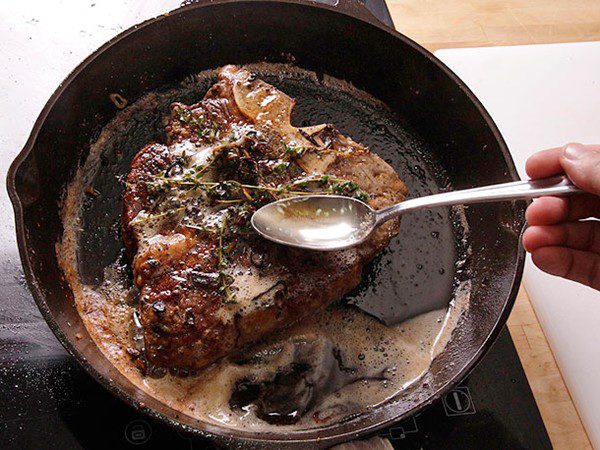
The steaks weren't juicier, they did not cook faster, and the flavor was indistinguishable from a steak that was sauced with herbed butter after cooking. You might expect Young to abandon the practice - but you would be wrong. The chef says he will continue to baste, partly because it made the beef stay hotter before serving but mostly because he "believes the process of basting is satisfying and fun to do." Basically, he will do it because he likes doing it.
Most of us probably have one or more kitchen practices that we continue to do even though they we have learned more efficient methods or now understand that the process isn't technically necessary. If someone would ask why we continue with a method that is not backed by science, the answer may simply be "because I like to do it this way." It may remind us of the way a loved one used to cook, or the process may be meditative or otherwise comforting. If it makes you happy, that is reason enough to continue, even if it is not borne out by science.
6 comments
KatieK1
JimCampbell
I add the oil and onions to a cold pan and turn the heat to medium low, and, put a lid on to get them sweating.
After I take the lid off and turn up the heat they finish off quickly.
Darcie
Darcie
averythingcooks
Darcy14