
The easy access to AI image generators have made it almost absurdly easy to get lifelike renditions of scenes that have not and will not ever exist. I've seen dreamy "libraries" and even entire "houses" rendered by AI tools like Midjourney and others that were - at first glance - convincingly real. All you need is a prompt and the algorithm does the rest. Recently, parents and their children were drawn in by such imagery to what was billed as a "Willy Wonka experience" in Glasgow. The promotional materials, created using AI, depicted a wondrous event with images of a magical landscape in a kaleidoscope of colors reminiscent of a high-budget film set.
However, when the families arrived they found a mostly bare warehouse with cheap plastic props and a small bouncy house. Social media posts of what was promised versus what was delivered illustrated the stark contrast between the promise and the product. It was so bad that someone called the police! The event organizers ended up apologizing and refunding the ticket price, but that does not completely make up for the disappointment those children felt (ironically, a fairly accurate parallel of what happened in the original story). I suppose the moral of this tale is that you can't believe everything you see in promotional materials, especially now that entire scenes can be conjured in seconds.
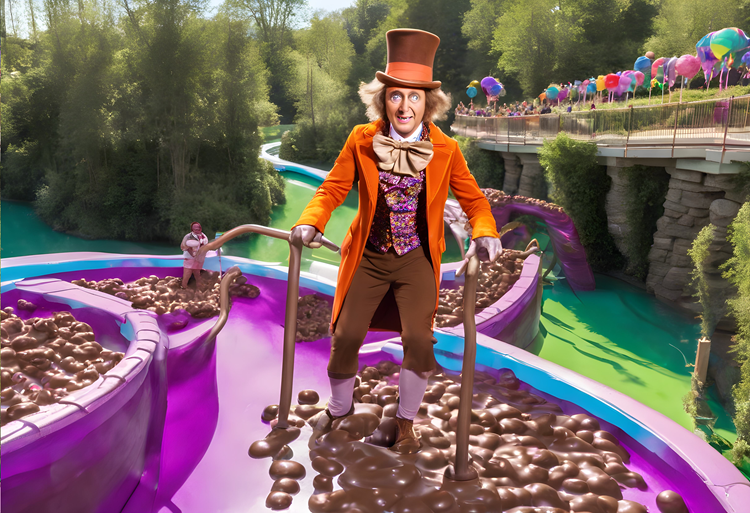
To show how easy it is to make this kind of promo, I entered a prompt of "Willy Wonka experience chocolate river Oompa Loompas " into a free AI image generator, and what I received a few seconds later is the image in this post. Like many AI generated images, if you don't look too closely it isn't half bad - a whimsical image that evokes the fantasy of the original book and movie. Upon closer inspection, however, the details are unrealistic, odd, and in my opinion, downright disturbing (the eyes!).
While we usually use recipe images from the EYB Library or photographs we take ourselves to illustrate EYB blog posts, we have occasionally purchased rights to use a stock image. One company we have used for this purpose has been promoting - nay, pushing - their new AI image generator for several months, but I have not (and will not, save for this post), use the tool because I would rather pay a real person for a quality image than use a tool that makes it harder for photographers to make a living, even if it does save a few bucks. The same goes true for AI copy in blog posts, which as I have mentioned before, is not something EYB is interested in using. We think our Members deserve better than a word salad assembled by a bot or a creepy image designed by AI. The downside risk for Members is that they must occasionally endure bad puns in blog titles like this one. That's a small price to pay, don't you think?
5 comments
janecooksamiracle
Indio32
Looking at it in a wider context go back 30 years and look at what supermarkets were selling compared to now. There are a huge number of ingredients that it's no longer possible to get as slowly, slowly supermarkets have swapped them for much more profitable ultra-processed variants.
pitterpat4
TeresaRenee
I am on the AI at work. We’ve been using ChatGPT for some specific tasks and have hilarious stories about its errors. I’ve told my kids to never, ever use it for essays or anything factual because it’s designed to be “creative”. I once asked for the top 10 Canadian Olympic high jumpers from the 1950s and it got all 10 wrong: age, sport, nationality, etc. I wish I was allowed to make that many errors and still be considered cutting edge.
My husband uses it at work to do first drafts of presentations. Then he goes through the content and ensures everything is factually correct. Last week he tried to get it to create a poster for a family ski trip. It never got the family name correct (each iteration used a different, incorrect name) and one of the posters showed the skier using skis as poles which my kids found hilarious.
An online retailer I use started using artificially generated photos of models for its clothing. I get creeped out looking at them and noticed I buy less clothing because I hate the images. I can’t figure out what’s wrong with them but they just don’t look like real people.
Fyretigger
AI does have its positive sides there as well. A San Francisco based AI company used its AI to analyze Wikipedia against published news articles and journals to detect under representation, particularly of women in particularly science on Wikipedia. The AI found 40,000 entries that should exist, based on Wikipedia's own criteria, and it created fully cited summaries for human review and possible inclusion. Those further interested can search for the Wired article "Using Artificial Intelligence to Fix Wikipedia's Gender Problem".