
"Jump to recipe." If seeing those words in a blog post to which you've navigated after seeing an image float across your social media feed makes you happy, this post may not be for you. The internet is rife with people joking about what they view as exaggerated prose that precedes the recipe in a food blog. "I just want the recipe!" they exclaim, as if the text that accompanies the list of ingredients and instructions can always be easily divorced from the latter.
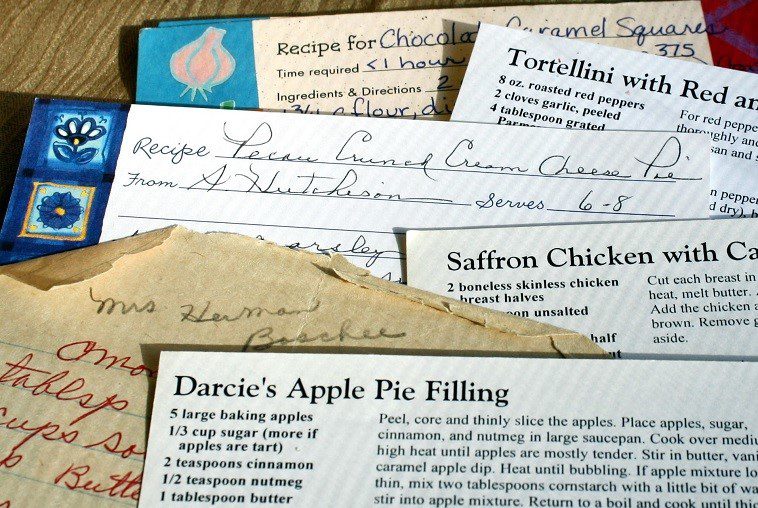
While this may be true for some blogs, it's not that cut and dried, says food writer Alicia Kennedy. In a recent Substack post, Kennedy opines on what she calls an "embodied approach to recipe writing," making the case that the prose preceding a recipe is not a separate object that can easily be discarded, but is rather a central part of the recipe itself.
I don't want to quote extensively from this article, because in the same way that Kennedy argues that a food writer's story is as much a part of the recipe as the ingredients and should not be bifurcated from it, bringing in a snippet of the article as a pull quote does injustice to the piece in its entirety. It's better if you read the whole thing. And if you are the type who always skips straight to the recipe, I will warn you that there isn't one in Kennedy's post.
5 comments
averythingcooks
Rella
If the recipe looks 'somewhat' interesting, I'll skip right to it and see if any of the ingredients might be adjusted by yours-truly; i.e., sugar, eggs, milk, meat. Then I'll read about the writer to see if the writer has any more great ideas for me. This has been the path to purchasing a lot of my books.
anniette
Mary Cantwell was a beautiful, seemingly effortlessly lyrical, writer, who wrote about food, but about art and writers and history and life. As a devoted Cantwell and Mademoiselle reading teenager, I was introduced to Matisse and Pellaprat, Escoffier and Edna Lewis, Lord Peter Wimsey and Marcella Hazan, Gertrude Stein and Alice B. Toklas, Pearl Bailey and Vuillard.
The list goes on and on, and still affects and inspires me decades later.
I still cook her recipes, French inflected, practical, and delicious.
I wish every young cook had her erudite and elegant, but chatty and whimsical, columns to read each month, as I did.
I am a dedicated lifelong cook and serious cookbook collector, and I believe the flame was lit by Mary Cantwell's EAT column. (She was later on the editorial board of the New York Times, and published a well-regarded memoir in trilogy.)
antimony
MaineDruid
I've been composing a cookbook style sheet over the past few years and am currently up to 15 pages, single-spaced. Much of my thinking on the issues focuses on trimming verbiage; if I'm in the throes of preparing a dish, I don't appreciate wading through the canals of Venice while the recipe's author reminisces about her honeymoon in Italy. A couple of days before I read Kennedy's essay I had done a riff on that very topic that had my husband rolling on the floor and declaring that I had missed my calling doing standup.
So I have been one of those "Just the facts, ma'am" types who typically zero in on the recipe, bypassing the food porn and the blow-by-blow documentation of every flick of a whisk or autopsy of an artichoke. It's not that I think the context of a recipe's creation is irrelevant. Some of my favorite cookbooks are likewise autobiographies or travelogues, even treatises on philosophy or theology (check out "The Book of the Lamb"). But the list of ingredients and directions do need to be separate, distinct, and to the point.
Kennedy's introduction of the word "embodiment" and observation that online self-publishing has given a voice to the voiceless has given me a good scolding. She hints that this is in part a social justice issue. And, although not an exact analogy, it's an attribution issue. It puts me in mind of the fact that I remain seated in a movie theater until all of the final credits have rolled; I consider it profoundly disrespectful to the hundreds or even thousands of people whose effort and skill contributed to the film I have just viewed, to just get up and walk out the instant the action has concluded. This is much the same thing; the prose that introduces a recipe could be thought of as the opening credits. I shan't be so crass from now on.
On a related note, this has gotten me to speculate on whether ChatGPT could produce a viable cooking blog. I think not. The personal touch is essential--bring on the Venetian honeymoon.