
Thanks to virtual meetings and interviews - and the Twitter account Room Rater - I have seen gobs of bookshelves this year. It's easy to see why so many people chose to have a bookshelf in their Zoom background - it makes you look smart and sophisticated, unlike the unmade bed that you would see if I turned on my laptop's camera right now. As a book lover, I am always keenly interested in how people organize their collections, a topic that I have written about before.
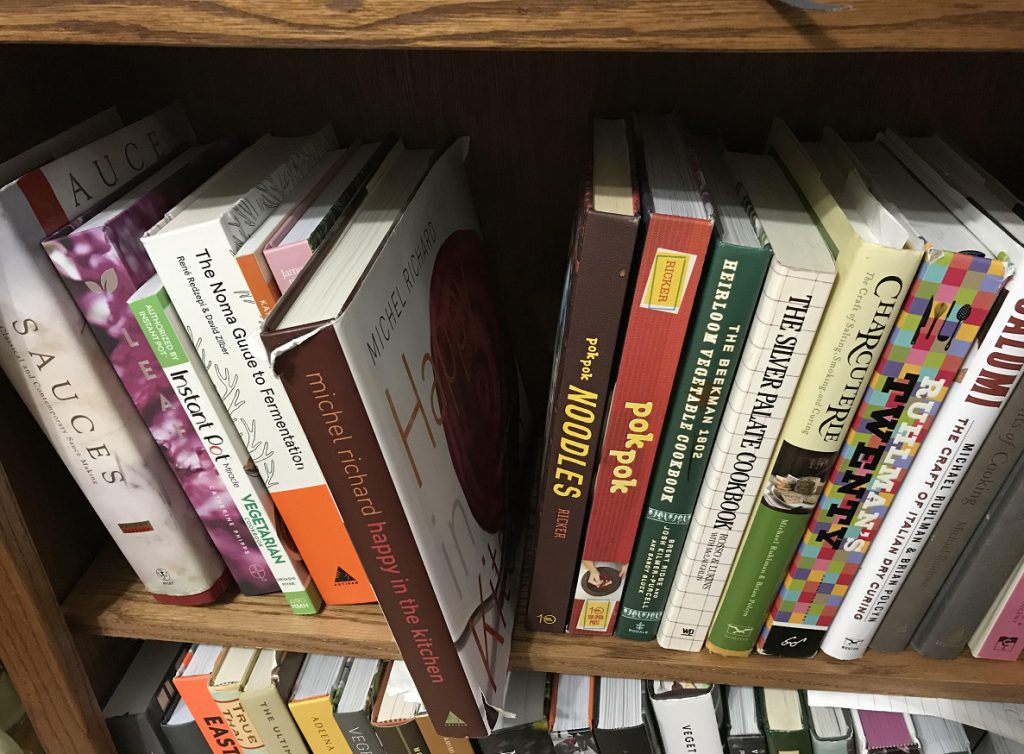
While Room Rater thinks that grouping books by color is bad form, they don't have much else to say about organizing bookshelves. I have developed a system that works for me 99% of the time - I split my books into categories: baking books, cookery books, reference books, cocktail books, and so on. Each category is arranged by the author's last name. It works...at least until I run into an oversized volume.
Most, but not all, of these are books written by famous chefs. You can see Michel Richard's book Happy in the Kitchen sticking out in the shelf above. If I place it in its proper alphabetical position, not only does it obscure the surrounding books, it often ends up getting bumped, causing damage to the book jacket or spine. My solution is to place the book on its side on top of the bookcase, joining other such unwieldy volumes like Alinea and Hot Sour Salty Sweet.
I don't mind slight differences in the heights and widths of books; if they were all the same size it would be boring. Widely disparate measurements (especially the length), however, set my teeth on edge. Not only is it difficult to shelve these monsters, if you actually want to cook from them they take up an inordinate amount of room when opened. In my small kitchen, I don't have counter space to spare, so I end up putting the book in the dining room and running back and forth, or wasting paper to make a photocopy.
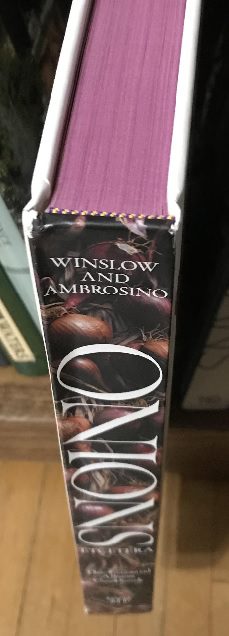
With everything that is going on in the world, I realize this is a minor quibble. Even in the best of times it is not a big deal. But it does cause me to use those cookbooks less often than others more conveniently sized. If a cookbook designer really wants me to love and use a book, she or he will incorporate a couple of bookmark ribbons. The icing on the cake is when books feature edge painting. The book Onions Etcetera boasts a lovely color on the page ends, fittingly reminiscent of red onions. It is a wonderful finishing touch and shows a level of care that is all too rare.
Typesetting is another area where a good design encourages me to come back time and again, but a bad one makes me want to put the book away. I don't particularly care whether the ingredients list is to the side or above the instructions, whether there is one column or two, I only want the type to be legible. Some authors (or publishers) choose avant garde designs that might be striking, but if I can't read it without getting a headache, I'm not going to use it. Luckily those books are few and far between.
How do you handle oversized books, and which cookbook design features appeal to you?
13 comments
Fyretigger
Legibility refers to the idea that you can 'clearly" make out what is printed (think DMV eye test). Eat Your Books is an example of legibility. The font is sans-serif (that is, the font is very rectilinear, without embellishments -- characters generally look as they would when you hand print them, a capital T is 2 straight lines).
Readability refers to the idea that the font facilitates rapid reading. The font has serifs, little embellishments to the characters. A capital T has tiny extensions at the base, like feet. Enough characters have these at the bottom and top, that it gives the eye a line to follow, sort of a railway track -- this allows you to read it much more rapidly. Narrative books (novels, etc.) are almost exclusively printed in serif fonts.
San-serif fonts like Eat Your Books uses are perfect for instruction, like a recipe. You can't read them as quickly as a serif font. You are forced to slow down and you will absorb more of the material.
You asked how we handle oversize books and organize, so here it goes.
One of my COVID quarantine projects was creating a new home for my cookbooks. For years they'd lived on narrow and wide floating shelves above the window at the front of my kitchen. But after 25 years, the supports were suffering under the constant weight of the cookbooks and sloping dangerously into the room. Clearly they needed more support.
I opted for a 7' tall IKEA bookshelf that fit neatly into a dead spot between the end of my kitchen counter and a side window. Then I needed to organize my collection into roughly 15" wide segments.
So here is what I did... I worked outward from the middle.
The shelf at roughly waist level I dedicated to my heaviest books, which also happened to be 'technique' books -- "The Professional Chef, America's Test Kitchen and so on. So I filled out the rest of the shelf with similar books. Here also went the large ring-bound version of the family cookbook.
The bottom shelves I dedicated to home design, gardening and home maintenance books.
In-between (below waist level), I placed most of my collection of specific cuisine books, a mix of ethnicities (Mexico, Ireland, China, India, etc.) and styles (Grilling, etc.)
The first shelf above waist level ended up being a chef shelf. It mostly contains Jaime Oliver. And no, I'm not a groupie -- I inherited a number of titles from a friend-of-a-friend who was a cookbook reviewer.
Above that shelf is a catch-all shelf -- America's Test Kitchen Family Cookbook, several restaurant/resort cookbooks (Esalen, Millennium... a hot springs resort in my home state of Montana...) along with an isle of misfit toys of cookbooks approach (gifted state cookbooks, Martha Washington's cookbook, Instant Pot cookbooks and so on).
Sitting on the tallest enclosed shelf, is my Le Creuset tagine, which will be booted to the top of the bookcase as my collection expands.
GenieB
averythingcooks
The 2 design features that frustrate me the most are....
1. Books that will NOT stay open easily, even when in my wooden counter stand with little metal brackets to hold the pages
AND
2. Fractions that are themselves the size of other numbers (ie that DON'T appear as 1/2, 3/4 etc ; I can read all ingredient amounts easily EXCEPT those darn tiny fractions and usually need to use the light/magnifier on my phone (even with my cheaters on) to actually read what they are.
And yes.....these are small problems in a big world :)
LeilaD
nwaterman967
I have 132 Kindle cookbooks organized by category: Baking, Greens/Beans/Roots, Desserts, General/Fish, Instant Pot/Pressure, Mexican/International, Misc., Soups, Veggie & Other Food Related. If there is a print cookbook that I use a lot, I try to get a reasonably priced digital version if possible. (I watch for them on Eat Your Books regular Kindle sale lists.) I like that digital books are pretty easy to rearrange and to add categories as my cooking interests change and expand. Also, I can put the same cookbook in multiple categories if it makes sense to do it. (Handy for those cookbooks that seem to cover everything but have a major section on something that especially interests me.)
I totally agree with averythingcooks about fractions. Why do so many cookbooks have to make fractions into teeny tiny things you need a magnifying glass to read? Makes no sense.
My other cookbook peeve is when digital cookbooks don't have linked indexes. It makes it so much more challenging to find things without links. Sometimes they'll add a note along the lines, of "use the index to find recipe titles to search for" but I think they should take the time to add links. Sometimes the recipe titles don't even match the index so you still have to poke around for awhile to find it. (Usually this missing index links thing happens with older cookbooks, so I imagine they don't think it makes sense to take the time to do it, but it makes a big difference in usability.) I use these books much less often.
vglong29
readingtragic
hillsboroks
lkgrover
My books are generally arranged by theme, and I have a bookcase for cookery & one for baking/desserts. For the cookery books the order is: cooking method, ingredient specific, course specific (except tea), regional (North America, South America, Europe, Africa, Asia -- alphabetical within continent). Then baking/desserts: general, by type (cakes, pies, cookies), ingredient specific, afternoon tea-focused, regional baking by country. All volumes of Bake from Scratch are on the bottom shelf because they are heavy.
pokarekare
Jane
sanfrannative
Color works for me because when I think of a book but can't remember the title the color of the book always pops up in my head. Is it yellow? I browse the yellow section and, voila! And it looks pretty to boot.
DeborahG
I guess the other difference is that they’re in different rooms. In the kitchen I have a 5 shelf unit built in, where I rotate books I’m trying - a mix of new and old - and keep favourites. The top 3 shelves are cooking, the bottom baking / bread / dessert.
There are a couple of floating shelves beside the coffee machine and these hold a dozen newish books that I’m looking to get more familiar with - currently Indonesian, Korean and Japanese books with Duck Soup and Trullo alongside. The idea is that I’ll browse while having a coffee. Below the shelves, the Ferrandi bibles (Patisserie, Grand Cours de Cuisine) sit. The former is really well used, even though I’m not really a pastry person.
Elsewhere in the house there are two large (groaning) bookcases, one of which has doors, which hold pretty much everything else, though my folders of recipes torn out of magazines and the ancient but much prized multi volume Cordon Bleu cookery course picked up in a book sale, live in a cupboard under my sewing bench.
And sadly there are boxes of books in store while we wait to move house. It was tough to decide which books I could live without, and while there are regular irritations about missing books, by and large the experience is allowing me to dive deeper into the books I have.
Design features: I loathe books that use light coloured fonts. It’s a bit like people who don’t cook designing kitchens. Unworkable. I have quite a few E-books too, but I’m nearly always disappointed by how poorly produced they are - especially regarding indexing - and generally if I do find one I like and REALLY want to make good use of, I’ll buy the paper version.
Like vglong29 I take pictures of recipes with me when travelling - useful for doing Christmas at my Mum’s for example!