
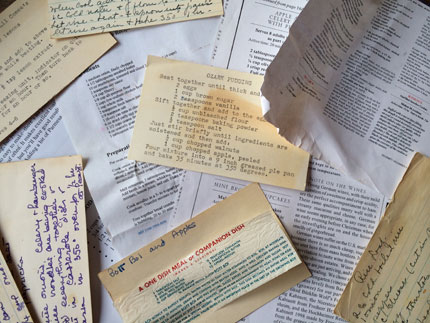
Given the number of cookbooks represented on this site, we thought an Epicurious article about The Biggest Mistakes Recipes Writers Make might hit a familiar note with our Members. So as assurance that you're not alone when you fume over a poorly written recipe, here's a summary of the Epicurious' list of all-too-common recipe mistakes, with our comments, plus a couple of our own:
Size Is Relative: What is a "large" or a "medium" onion? Please try to use two different measurements ("one medium onion or one cup chopped onion") if possible.
Forgetting to Add the Reserved Ingredient: It's why you should mise en place religiously, but it's still incredibly aggravating.
Juicing Citrus Before Zesting: We can understand this problem. It's like a traffic rotary where two road rules (yield to the car on the right, the car in the rotary has the right of way) contradict. In this case, the rule for recipes is always to list ingredients in order of usage, so juice is often listed before zest. But given how hard it is to zest a cut lemon, etc. the juice listing could mention that the fruit should be zested and the zest held for future use.
Covered versus Uncovered: Supposedly, "there is an unwritten code among recipe writers that there's no need to mention the pot lid unless the recipe instructs you to cover the pot." But we agree that many cooks are not going to know that, so just add the words "covered" or "uncovered."
Canned Tomato Confusion: Whole, diced, mini-diced, with basil, with garlic, fire-roasted - the variations go on and on, so the type of canned tomatoes should be mentioned (and this holds for other canned goods as well).
The "Copy and Paste" Mistake: Per Epicurious: "If the writer is working on multiple recipes within a theme, such as pies, and similar wording occurs among the recipes, the ease with which he or she can copy and paste paragraphs of instruction from one recipe to the next is too tempting to ignore. The problems arise when there are variations within the standard wording. For instance a feature on pies might include rolled out butter pastry crusts, press-in dough crusts, and cookie-crumb crusts. The moral here is to read and reread your recipes several times, preferably with fresh eyes."
We agree with these, but here are a couple of personal ones we'd add to the top list:
Not giving two different methods for telling when a dish is done. Given that a) ovens can be notorious for being off-temp, and b) variations such as whether the dish is started at refrigerated or room temp, or container size, it is inexcusable for a recipe just to give a time for baking, etc. It should also specify appearance or another way to tell if done.
Serious baking books that don't include weight measurements along volume measurements. It's accepted that weight measurements are more accurate than volume, and many bakers now have scales - so if a writer, especially a baking author, wants to be taken seriously, then the book should have weight measurements.
Any you'd like to add?
Photo courtesy of Kemp Minifie
18 comments
Queezle_Sister
fprincess
FJT
nadiam1000
debkellie
Christine
susan g
I notice that some of the problems show up more in my older cookbooks, especially the illogical order of ingredients, but the need for improvement hasn't ended yet.
DKennedy
Not clarifying if nuts used in a recipe should be raw or roasted/toasted.
boardingace
Anyhow, loved your post!
matt478
rhelune
jdl958
sir_ken_g
veronicafrance
SusanN
blueeyedmaiden
FuzzyChef
This also tells me that they didn't actually test the scaled down recipe, which means that I have no reason to believe it will work. That's why this is my biggest hate; it shows contempt for the reader.
wester
On relative size: Celeriac recipes always turned out weird with me - until I got Cook This Now that told me it should be "the size of a navel orange - about 4 or 5 inches diameter". Now that's clear, and it told me that Dutch celeriacs generally are at least twice as big as others. This is what measurements should be like.
I don't agree with the canned tomato thing though - canned tomatoes are canned tomatoes, and if the recipe says canned tomato, canned tomato will do. I do dislike recipes that call for "tomato sauce" without any clarifications though.