
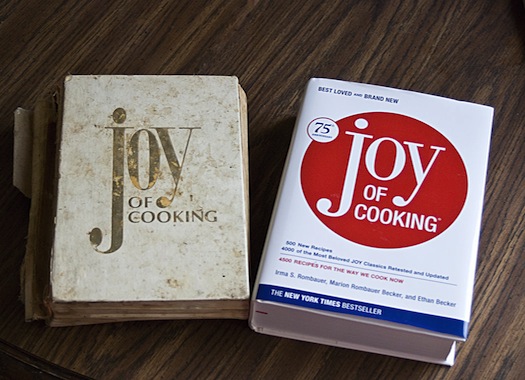
Given the number of members who own a copy of Joy of Cooking (well over 3000), we're assuming that this iconic cookbook needs no introduction. Since it was first published in 1931 by Irma Rombauer, assisted by her daugher Marion Becker, there have been eight editions of Joy, and some have been accepted eagerly and some with controversy. Given how many of us probably still have older copies, or are tempted to purchase older copies, it's interesting to note the the story of the most significant versions:
The 1964 5th edition was the first published after Irma Rombauer's death and without Marion's consent. It was rampant with errors, and subsequent editions (which Marion edited) dealt mostly with cleaning up all the errors in this edition.
The 1975 6th edition is the biggest seller of all the editions and is considered by those who have it (including us) the book that is truest to Rombauer's vision. It was the last edition edited by Marion Becker.
The most controversial edition, the 7th edition published in 1997, was ghost-written by a team of chefs, dropped the first-person folksy style, and introduced a lot of international cuisine and more sophisticated cooking. It also eliminated many simple or down-home recipes, especially in the dessert and preserving sections, as well as ingredients (e.g. substituting bechamel for cream of mushroom soup). The New York Times once referred to it as "The New Coke of cookbooks."
The 8th edition, pubished in 2006, is also known as the 75th Anniversary edition. It reverted back to the Rombauer style both in voice and with a return of much of the excised information of the 1997 edition, along with the simpler recipes. It was sponsored by Rombauer's grandson.
We were inspired to write this when we noted that the Kitchn is asking its readers, Do You Have a Favorite Edition of Joy of Cooking? It can be a little hard to compare since only the 7th and 8th editions are in print, but as the 1975 edition was the biggest seller, it can still be found fairly easily.
As might be apparent, we love our 1975 edition - which was effectively our first cooking instructor - and we'd vote strongly for it. But we'd love to hear your opinions. And just for nostalgia sake, here is the recipe that I think many people first cooked from the book - Chicken Divan - and still one that many people probably remember very fondly.
Photo by Corazonde Dios
10 comments
susan g
ellabee
ellabee
geoff@kupesoftware.com
geoff@kupesoftware.com
sir_ken_g
I also have a 1965 Fanny Farmer. Used to have a newer one but gave it away - missing too many classics.
NaomiManygoats
Why can't I get into Joy? Because the format of all of them really turns me OFF in a big way. I dislike the cheap paper. I would say the lack of photos is not encouraging, except that I LOVE, and use a lot, the Fannie Farmer (Cunningham) cookbooks, and others like the Moosewood cookbook that have no color photos. So it's not that.
What it is, is the Double Column format that turns me off in a big way. Perhaps it reminds me of being a kid sitting in Church trying to make out the double column Bible in King James. Bibles have moved on to modern language, and one column formats with larger fonts. Why can't Joy?
I know, publishers want to save space, and how may pages they print. But when I open a cookbook whose format is boring, ugly, and gives me claustrophobia, the last thing I want to do is cook from it, because I don't want to sit in an armchair and read it! And reading it to find recipes is where it starts for me.....unless of course it pops up doing a recipe search for something specific in Eat Your Books!
lesorelle
susan g
MysteryChef
The 2006 (75th edition) attempts to recreate the magic but doesn't quite get there. It has inaccuracies and changes that do not enhance the book.
My next purchase will be a 1975 edition for my daughter and a 1931 facsimile.
I found a 1975 hardbound edition in a discount store and bought it, and cling to it for dear life. It is a "go-to" book, along with Betty Crocker (1956 edition) and The Ball Blue Book.